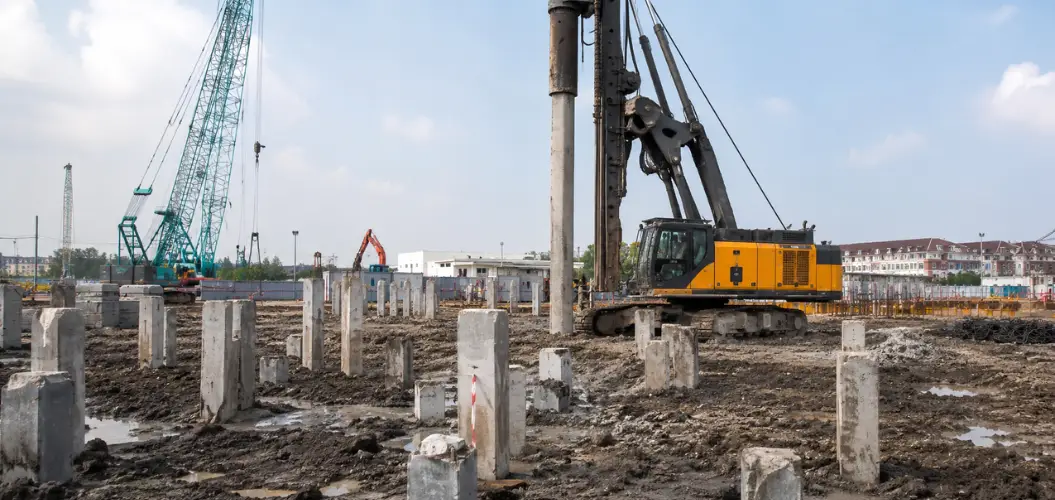
Piling is a deep construction technique used when the upper layers of the soil are too weak to hold a construction load. In this process, long columns of concrete, steel, or timber are drilled deep into the ground.
Piling in construction is mainly used for buildings, bridges, waterfront constructions and sites requiring a deep and solid construction base.
When to Use Piling in Construction
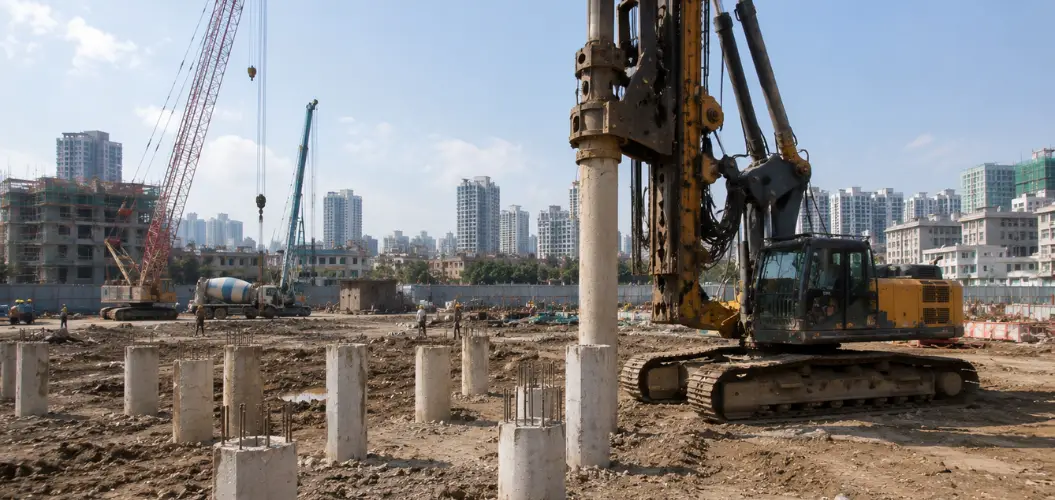
Pile foundation is required for sites that lack soil strength. If the soil is weak, wet, loose, or uneven, deep foundation technique provides a reliable base.
Piling is also needed when the load is too high, to reduce settlement, or when there is an existing excavation. In general, piling is necessary in cases of:
- Weak soils
- Heavy loads
- Minimal settlement
- Excavations
- Where foundation support is needed at a deeper level
Pile Types in Construction
No single type of piling fits all types of construction services. Different soils require different construction techniques. However, the purpose remains the same, but there is a variety of materials, techniques, and sizes for piling in construction. Some commonly used piles include driven cast-in-situ concrete piles, bored cast-in-situ piles, driven precast concrete piles, precast piles inserted in already dug holes, timber piles, and under-reamed piles.
1. Driven piles
Driven piles are driven deep into the earth through a hammer or any other equivalent device. This is usually done when the soil is easy to displace. Besides, this is done when there is a layer of soil that is much stronger than the current one. In order to make driven cast-in-situ piles, the casing should be driven first, before pouring the concrete.
2. Bored piles
These types of piles are installed using a drilling machine, after which concrete and reinforcement are inserted in the drilled holes. They are ideal where vibrations need to be minimised due to proximity to already constructed buildings.
3. Precast piles
These piles are made in advance at the casting yard, and transported and then driven or put in their place. Their main advantage is consistency since they are pre-cast.
4. Under-reamed piles
These piles are designed specifically for certain situations where the foundation needs to be strengthened using a bulbous base underneath the shafts.
5. Piles made of wood and special piles
Even today, timber piles find applications where their use is feasible, whereas special types of piles can also be employed under special circumstances, either in terms of the geological formation, accessibility, or loading conditions. The objective is not to go for the most sophisticated method.
How a Pile Foundation Is Carried Out
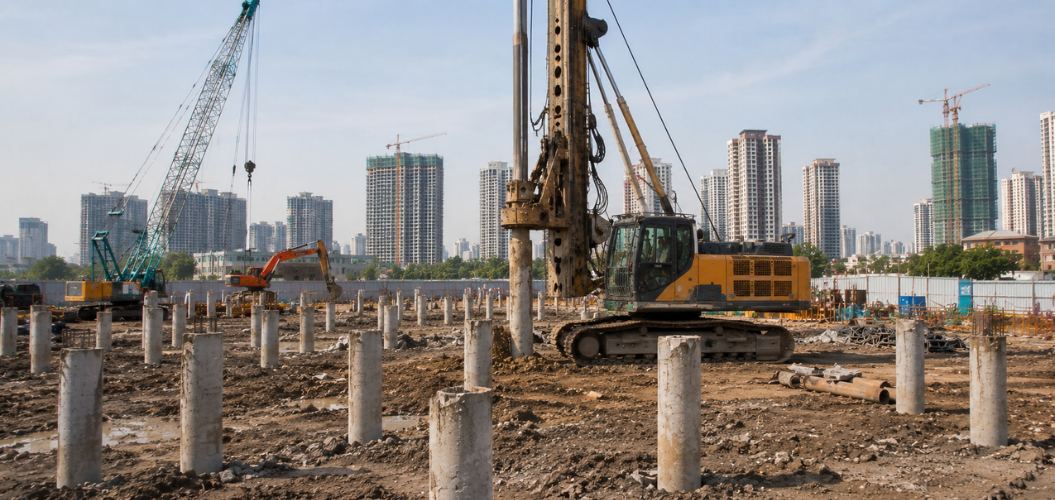
Piling in construction services varies according to the nature of the project, but it generally involves a standard process. Proper piling requires adequate control of positioning, depth, alignment, and execution. The pile may be robust, but if it does not fit well into the soil, it may fail.
It includes the following steps:
Ground investigation and design
The engineers investigate the ground conditions, the weight, and the settlement restrictions to select a suitable pile system.
Pile layout
This involves laying out the pile positions on-site to ensure that the foundation corresponds to the design requirements.
Installation
The pile is driven, bored, or cast in place, depending on the chosen method.
Quality assurance and testing
Load testing might be employed to determine whether the pile can perform effectively and efficiently.
Where Piling is Applicable
Piling is implemented in various types of construction services; however, it plays a significant role in cases where the soil cannot withstand the weight by itself. Such projects include residential constructions on difficult sites, domestic structures, commercial construction, basement floors, retention systems, and development plans requiring more settlement control.
Piling also helps in delivering improved structural designs in high-quality construction work. It provides the flexibility to designers and constructors to come up with open layouts, high elevations, and elegant designs, knowing the base is doing its work quietly below. That balance between structure and design matters more than people often realise.
Conclusion
Piling is not the most visible part of a project, but it often decides how well the project stands over time. It is one of the elements people rarely think about until there is a problem. That is why it needs proper planning, the right method, and careful execution from the beginning.
With a good understanding of the groundwork, the rest of the construction process can go on smoothly.
Frequently Asked Questions
- Does piling make construction more expensive?
Piling can increase initial foundation costs, but it often prevents future structural issues, repairs, and uneven settlement that could become far more expensive later.
- Can piling be done for residential homes?
Yes, piling is commonly used for homes built on weaker soil, sloped land, or plots where standard shallow foundations may not provide enough support.
- How long does piling work usually take?
The timeline depends on soil conditions, project size, pile depth, and site access. Smaller residential projects may take only a few working days.
- Is piling noisy during construction?
Some piling methods create vibration and noise, while others are quieter. The chosen technique usually depends on surrounding structures and site conditions.
- Why choose RS Builders for piling and construction services?
At RS Builders, we focus on quality construction services with careful planning, reliable foundation solutions, and practical execution methods suited to different soil and project conditions. From planning to execution, our team focuses on structural reliability, precision, and quality workmanship to help ensure long-lasting construction results.