If you spend enough time around building sites, you start noticing patterns. Some materials come and go depending on the project. Some stay common because they just make practical sense. CMU is one of those.
That’s why CMU in construction keeps showing up in both homes and larger buildings. It is not a flashy material. No one talks about it the way they talk about finishes or façades. But for wall construction, it does a lot of things well.
Builders usually prefer it because it is strong, consistent in size, and quicker to work with than many traditional options. And when the goal is to build something stable without slowing the whole project down, that matters a lot.
What Is a CMU (Concrete Masonry Unit)?
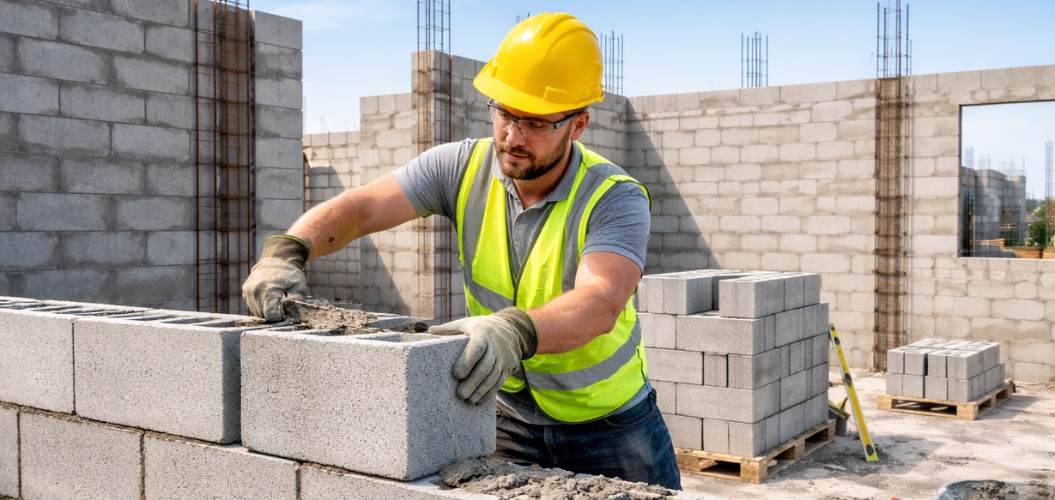
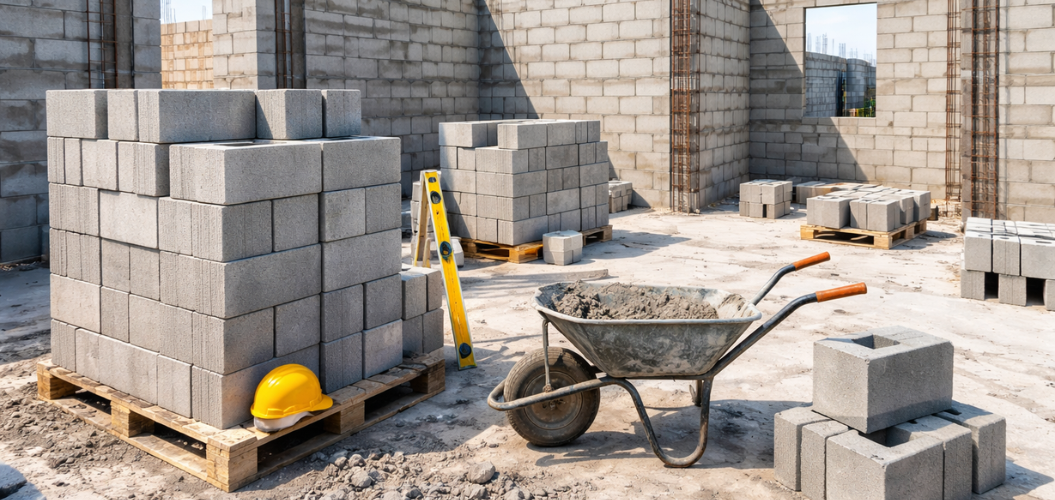
A CMU, or Concrete masonry unit, is basically a precast block made from cement, aggregates, and water. The mix is shaped in moulds and cured until it becomes hard enough to use in construction.
When people refer to CMU in construction, they are talking about these concrete blocks used for walls, partitions, and in some cases structural work.
The easiest way to understand CMU is to compare it with brick. A brick is smaller. A CMU block is larger, heavier, and usually more uniform. That larger size means fewer blocks are needed to build the same wall. Fewer blocks also means fewer joints, and that can speed things up on site.
It sounds simple, but on a real project, small efficiencies like that add up quickly.
Common Types of CMU Blocks Used in Construction
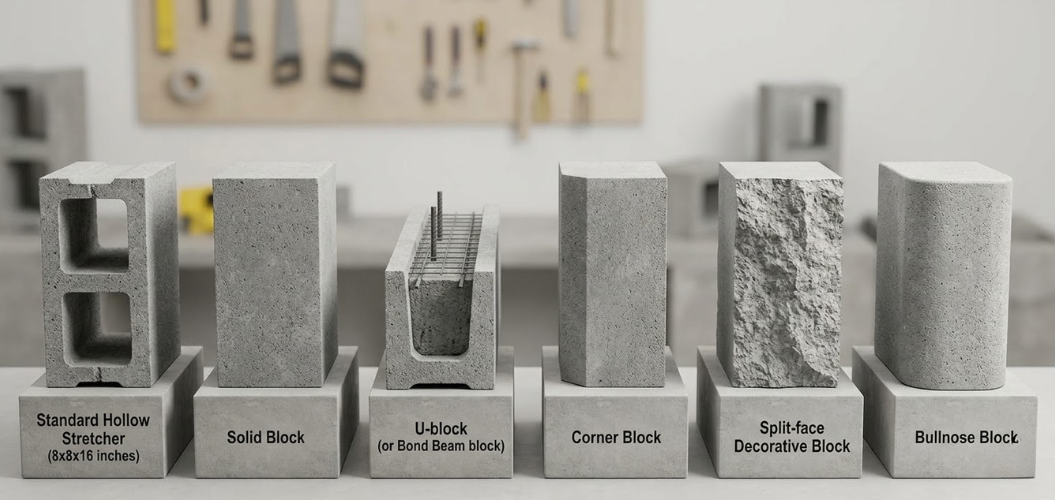
Not every CMU block is the same. Different projects need different block types, and even within the same building, more than one type may be used.
Hollow CMU Blocks
These are probably the most common type of CMU. They have hollow spaces inside, which makes them lighter and easier to handle while still keeping enough strength for many wall applications.
Solid CMU Blocks
Solid blocks are denser and heavier because they have little or no internal void. They are usually chosen in commercial construction projects where more strength is needed, or where a wall needs to feel more solid overall.
Lintel Blocks
Lintel blocks are used above doors and windows. Their shape allows reinforcement and concrete to be added so they can carry the load above the opening.
Partition Blocks
These are lighter and thinner blocks meant for internal walls. They are not usually used where heavy structural performance is needed. Their job is mainly to divide space.
Where CMU Blocks Are Used in Buildings
One reason CMU blocks remain so popular is that they are useful in many parts of a building.
They are often used for:
- Load-bearing walls
- Boundary walls
- Internal partition walls
- Infill walls in framed structures
- Basement and utility walls
That versatility is part of their appeal. A material that can work across different wall types gives builders more flexibility.
In some projects, CMU is used mostly for partitions. In others, it becomes a more important structural component. It depends on the design and the engineering requirements.
Key Benefits of Using CMU in Construction
There are several reasons why CMU in construction remains a practical choice.
Some of the main benefits are:
- Strength
CMU blocks handle compression well, which makes them dependable for many walling applications.
- Fire resistance
Concrete performs well against fire, which is always a useful quality in a building material.
- Durability
When built properly, CMU walls can last a long time without demanding much attention.
- Cost efficiency
Since the blocks are larger, wall construction often moves faster, which can help reduce labour time.
- Low maintenance
Once the wall is complete and finished properly, it usually does not create frequent repair issues.
Important Considerations When Using CMU Blocks
A lot of people focus on the block itself and forget that workmanship still decides the outcome.
A few things matter a lot:
- The mortar mix has to be correct
- Reinforcement has to be added where required
- Waterproofing should be considered early
- The blocks need proper line and level during laying
These are basic points, but they are also the points where problems begin if people get casual. A wall built with good blocks can still underperform if alignment is poor or joints are weak.
That is true for almost every material in construction, not just CMU.
Role of Experienced Builders in CMU Construction
CMU work can look straightforward from a distance. Stack blocks, fill joints, move on. But anyone who has actually dealt with site execution knows it is not that casual.
Alignment matters. Joint thickness matters. Reinforcement placement matters. Even how the first course is set out matters, because every line above follows it.
This is where experienced teams make a difference. Recognised construction firms usually treat masonry as something that needs proper supervision, not just labour. Professionals like Ravijeet Singh often speak about long-term construction quality, and CMU work fits directly into that thinking. A wall may look fine on handover day, but the real test comes later, when the building settles into regular use. That is why careful execution is not optional here.
Conclusion
Some materials stay relevant because they keep proving themselves. That is really the case with CMU in construction.
It is strong, practical, and adaptable and works for partitions, boundary walls, structural walls, and several other applications. It also helps projects move at a reasonable pace, which is never a small advantage.
More than anything, CMU remains useful because it is dependable. When chosen properly and installed with care, it does its job well and keeps doing it for years. And in construction, that kind of reliability goes a long way.
Frequently Asked Questions
- Is CMU the same as brick?
CMU and brick are not the same. Manufacturers make CMUs from concrete, while they make bricks from clay. CMU blocks are bigger than bricks. Builders use bricks for building and decoration. Builders mostly use CMUs for construction. - Is CMU the same as cinder block?
No CMU and cinder block are not the same. Both are made of stuff, but CMUs are made of sand, gravel and other aggregates. Cinder blocks are made of coal cinders. CMUs and cinder blocks have materials. - How long is a CMU block?
A CMU block is 16 inches long. It is 8 inches high and 8 inches wide. The size of a CMU block can change depending on what you need for the building. - How long do buildings made of CMU last?
Buildings made of CMU last a time. CMUs are strong. Can withstand bad weather. They do not need fixing. That is why CMUs are long-lasting. - In what kind of buildings are CMU blocks mostly used?
CMU blocks are used in types of buildings. People use CMUs because they are strong and last long. CMUs are mostly used for:
1. Load-bearing
2. Partition
3. Foundation
4. Retaining
5. Outside work.