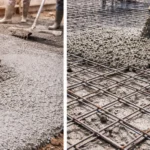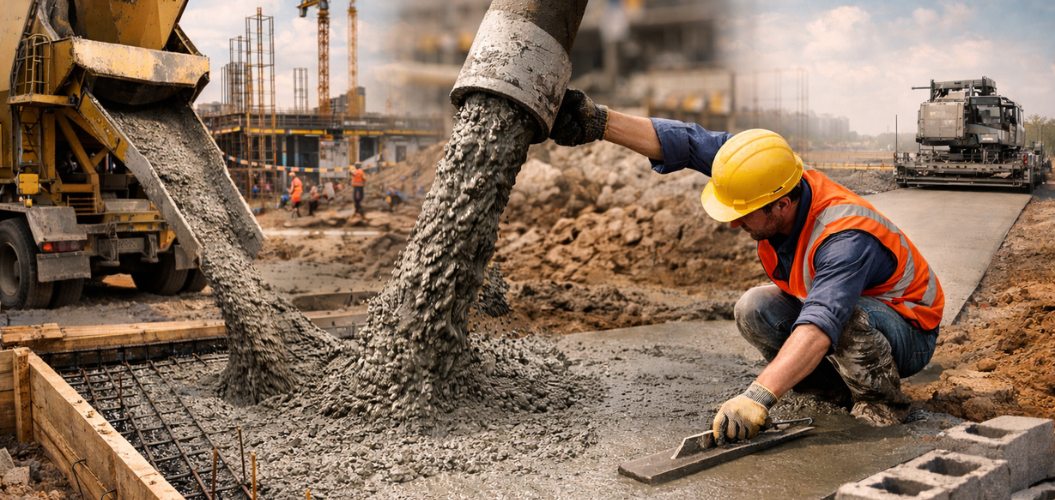
If you visit a site right after excavation is done, before columns rise or reinforcement is tied, you’ll usually see a thin grey layer poured across the ground. That’s PCC.
It doesn’t look like much. No steel bars. No complicated formwork. Just concrete spread evenly over prepared soil. But that layer is doing quiet, important work.
In pcc in construction, this first concrete layer acts as a base before the real structural concrete begins. It separates soil from reinforcement, creates a level working surface, and makes marking and alignment easier.
Most people focus on beams and slabs because they’re visible later. PCC disappears once the structure rises. But if that early layer isn’t done properly, small inaccuracies creep into everything that follows.
What Is PCC in Construction?
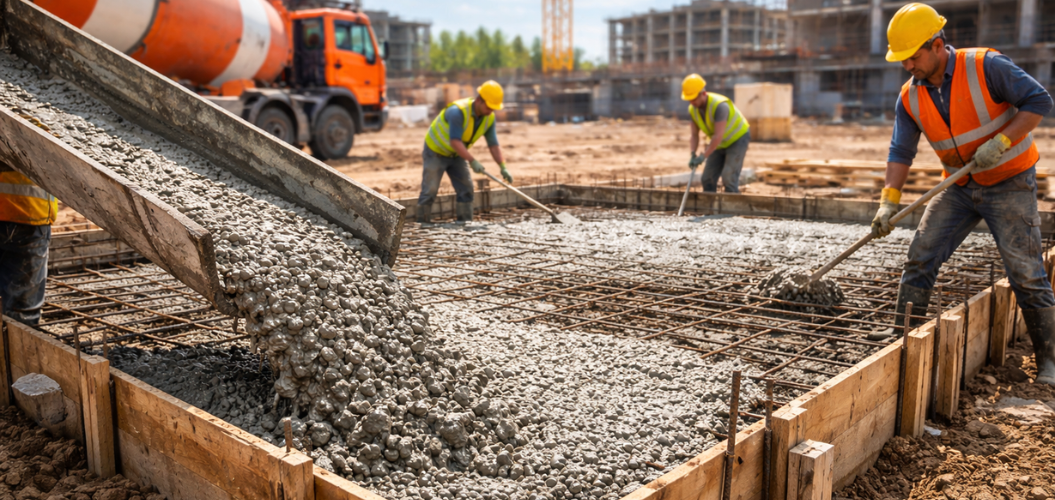
PCC stands for Plain Cement Concrete. In practical terms, pcc in construction is a mix of cement, sand, aggregates, and water, without any steel reinforcement. That last part is important. There’s no steel inside it.
Because it doesn’t contain reinforcement, PCC isn’t meant to resist bending or heavy tensile forces. It’s used where a simple, solid base is needed.
Think of it this way. If RCC forms the bones of the building, PCC prepares the ground those bones rest on. It doesn’t carry the structure, but it supports the setup.
That distinction is what separates it from reinforced concrete.
Why PCC Is Used Before Structural Work
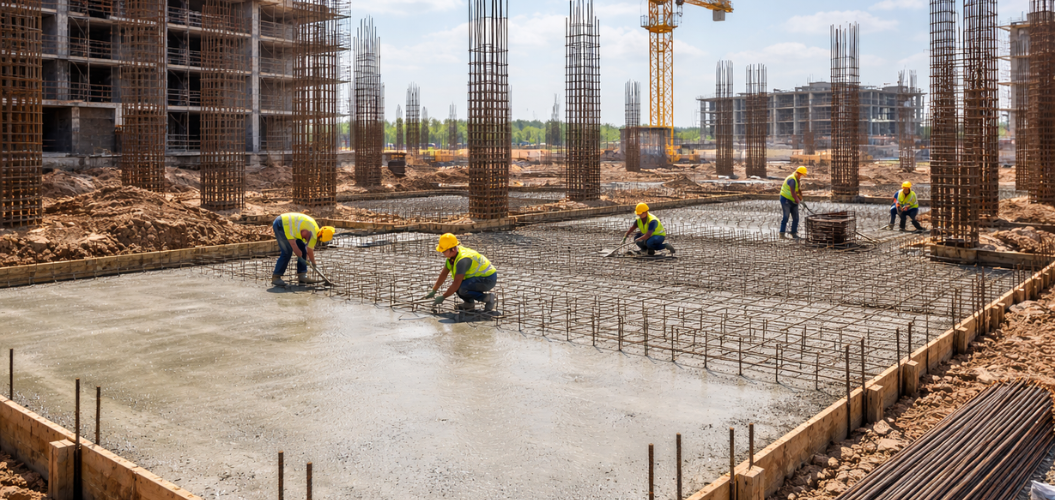
So why not place reinforcement directly on soil?
Because soil isn’t clean or stable enough for that.
Moisture, uneven surfaces, and loose particles can interfere with alignment and durability. PCC solves that problem in a straightforward way.
Here is what it does:
- Provides a flat, level surface
- Prevents reinforcement from touching soil directly
- Helps distribute minor irregularities
- Keeps the working area cleaner
When reinforcement rests on a stable PCC layer, footing placement becomes more accurate. That accuracy matters. Even small misalignments in foundations can affect upper levels.
Common Uses of PCC in Construction Projects
Below Footings
One of the most common applications of pcc in construction is below foundation footings.
Here, PCC acts as a levelling course. It ensures that the footing sits evenly and that reinforcement doesn’t touch soil directly.
It’s not designed to carry the load of the building, but it prepares the base so structural concrete performs better.
Flooring Base
On ground floors especially, PCC often forms the sub-base beneath final flooring.
Before tiles or marble are laid, a solid layer is required. PCC provides that.
If the base is uneven, flooring can crack or settle over time. That’s why this layer, even though hidden later, still matters.
Pavements and Sidewalks
For light-use pavements or walkways, PCC can serve as the main concrete layer without reinforcement.
Because there’s no steel, it’s economical and suitable for areas where heavy loads aren’t expected.
It’s practical. Not overdesigned. Just enough strength for the purpose.
Foundation Bed
In some projects, PCC is poured across the full foundation bed before column marking begins.
This keeps the site organised and provides a clean surface for layout work.
It also reduces the mess that comes with working directly on soil.
Standard PCC Mix Ratio Explained
The strength of pcc in construction depends on the mix ratio used.
You’ll commonly see ratios like:
- 1:3:6
- 1:4:8
These numbers represent cement, sand, and aggregate proportions.
For example, 1:4:8 means:
- 1 part cement
- 4 parts sand
- 8 parts aggregate
Higher cement content increases strength, but also cost. Since PCC usually isn’t structural, extremely high strength isn’t necessary.
The idea is balance. Enough strength to perform the role without unnecessary expense.
Water content also matters. Too much water weakens the mix. Too little makes it hard to place and compact properly.
Difference Between PCC and RCC
People often hear both terms on site and assume they’re interchangeable. However, they’re not the same.
Here’s the practical difference.
Reinforcement
- PCC: No steel
- RCC: Steel bars included
Purpose
- PCC: Base preparation
- RCC: Structural support
Strength Behaviour
- PCC: Handles compression mainly
- RCC: Handles compression and tension
RCC forms beams, slabs, and columns. PCC supports those elements indirectly by stabilising what’s below them.
Understanding that difference helps clients follow site conversations without confusion.
Importance of Proper PCC Execution on Site
Because PCC looks simple, some people underestimate it. That’s a mistake.
Execution still matters.
Important aspects include:
- Proper soil preparation before pouring
- Correct mix proportion
- Uniform thickness
- Adequate compaction
- Proper curing
If PCC is uneven, footings won’t sit correctly. If curing is skipped, surface strength reduces.
An experienced construction company knows that early-stage work sets the tone for structural accuracy. At RS Builders, PCC is handled carefully because once RCC begins, correcting the base becomes difficult. It’s easier to do it right the first time.
Common Mistakes in PCC Work
PCC mistakes aren’t always obvious at first. But they show up later.
Some common issues include:
- Adding excess water to make pouring easier
- Ignoring proper compaction
- Skipping curing to save time
- Using incorrect mix ratios
- Allowing uneven thickness
These may not cause immediate failure, but they reduce reliability.
Construction problems rarely begin dramatically. They start small and build over time.
Why PCC Matters in Long-Term Structural Stability
Foundations are layered systems. Soil, PCC, reinforcement, and structural concrete all interact.
PCC in the construction layer reduces moisture transfer from soil and ensures reinforcement remains protected. It also supports uniform load transfer to the ground.
When this base is consistent, upper structural elements perform better.
A responsible construction company understands that long-term stability starts with early-stage discipline.
Even though PCC disappears from view once the building rises, it continues supporting the structure silently.
Final Thoughts
Most clients don’t need to calculate mix ratios themselves. But knowing what PCC in construction means changes how they view early site activity.
Instead of seeing it as “just concrete,” they understand it’s preparation for structural work.
Simple awareness leads to better questions:
- Is the surface level?
- Is the mix proportion correct?
- Has curing been done properly?
Construction isn’t only about visible structures. It’s also about the unseen layers that create stability.
PCC may not attract attention, but it forms the starting point for structural accuracy. And in construction, the beginning always matters.
Frequently Asked Questions
- Why is PCC laid before structural work?
PCC is laid to create a clean, level, and stable base before placing reinforcement and starting structural foundation work. - What is the purpose of PCC in foundation work?
It prevents direct contact between soil and reinforcement, reduces moisture impact, and provides a firm working surface. - Which is better, RCC or PCC?
RCC is stronger and suitable for load-bearing structural elements, while PCC is used for leveling and base work—so both are important for different purposes. - How is PCC different from RCC?
PCC (Plain Cement Concrete) contains no steel reinforcement, whereas RCC (Reinforced Cement Concrete) includes steel bars to handle tensile and compressive loads. - What happens if PCC is not used before structural work?
Skipping PCC may lead to uneven surfaces, soil contamination of concrete, and reduced durability of the foundation.