When a house is being planned, most people focus on the layout, the look, and the budget. That is natural. But the part that really holds everything together starts much lower down. If the foundation is not right, the rest of the home can face trouble later. That is why the raft foundation is such an important part of residential construction.
So, what is a raft foundation? Put simply, it is a large reinforced concrete slab that carries the weight of a building across the full ground area. Instead of using separate footings at different points, the entire structure rests on one broad base. That makes it useful where the soil is weak or where the load needs to be spread more evenly.
What Is a Raft Foundation?
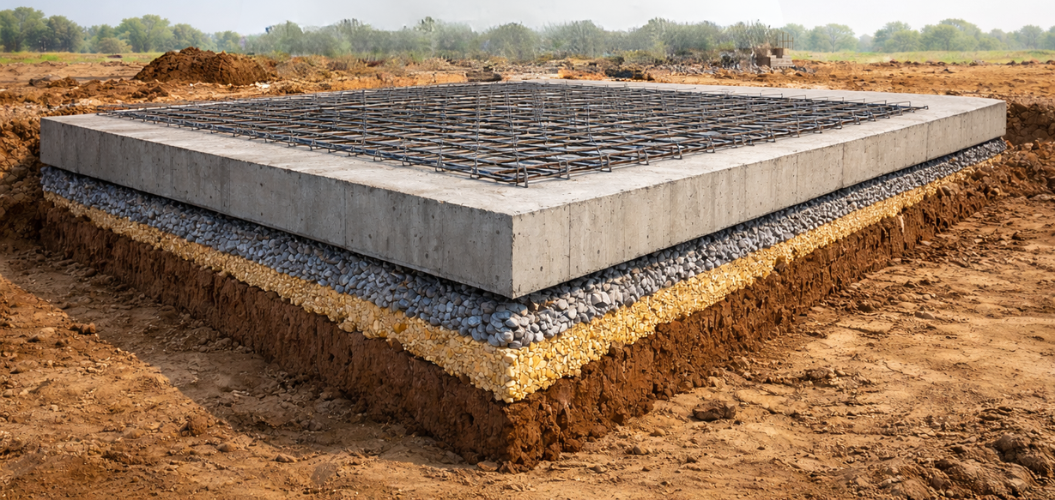 A raft foundation, sometimes called a mat foundation, is a single wide slab that supports walls and columns across the full footprint of a building. A good way to picture it is as a strong platform under the house. Rather than putting pressure in one small spot, it spreads the load across a much larger area.
That is what gives it value. In many homes, the soil below is not equally strong everywhere. A raft foundation helps reduce the risk of uneven sinking, also known as differential settlement. For homeowners, that means a steadier structure and fewer foundation-related issues later on.
In residential construction, raft foundations are often used when the plot is not suitable for isolated footings. They also make sense when columns are close together or when the building load needs wider support.
How Does a Raft Foundation Work?

The idea behind it is simple. The reinforced concrete slab spreads the weight of the building over a much larger surface than a regular footing would. This lowers the pressure on the soil and helps keep the structure in balance.
A raft foundation consists of the following components:
- A thick slab of concrete
- Steel reinforcement within the slab
- Beam supports in some cases
The load is spread evenly over the full area. The foundation will be less likely to settle unevenly. That is one of the main reasons it is useful on weak or inconsistent soil. It is not only about carrying weight. It is about carrying it in a stable, controlled way.
When Is a Raft Foundation Used in Residential Construction?
Not every home needs a raft foundation, but some site conditions make it a very sensible choice. It is commonly used in the following conditions:
- When the bearing capacity of the soil is low.
- When the soil is soft, loose, or clay-heavy.
- When the size of the individual foundations would be too large or would overlap.
- When the building has columns or walls close to one another.
When the building requires a large and stable foundation. The decision in residential buildings depends on the soil test report. That report shows how much load the ground can safely take. If the results suggest poor strength near the surface, a raft foundation may be the better option.
This is where experience really matters. The right foundation is not selected by guesswork. It is chosen after looking at the site, the structure, and the kind of long-term performance the home needs. That kind of planning helps keep the project safe and dependable.
Types of Raft Foundation
There is more than one way to design a raft foundation. The best type depends on the load, soil conditions, and building plan.
Flat Plate Raft Foundation
This is the simplest version. It is a plain reinforced concrete slab used for lighter buildings or where the loads are fairly even. It is straightforward to build, though it may not suit heavier structures.
Beam and Slab Raft Foundation
This type includes beams running under the slab for added strength. It is stronger than a simple flat slab and works better when the building load is heavier or more concentrated.
Cellular Raft Foundation
This design includes hollow sections or voids inside the foundation. It helps reduce weight while still keeping strength in place. It is used where lowering the load is important.
Piled Raft Foundation
This is a combined system where piles and a raft work together. It is used when soil conditions are very weak and the raft on its own is not enough. The piles help carry the load deeper into the ground.
Raft Foundation vs Isolated Footing
Many homeowners compare a raft foundation with an isolated footing, and the difference matters.
Isolated footing supports individual columns separately. It works well when the soil is strong and the loads are manageable.
Whereas a raft foundation covers the whole area and spreads the load more widely. It is better when the soil is weaker or when footings would otherwise become too large.
In simple terms, isolated footing suits simpler conditions. Raft foundation becomes more useful when the ground needs extra support.
Step-by-Step Construction Process of Raft Foundation
Construction of raft foundation involves a step-by-step process.
- Site Preparation and Excavation: The area is cleared and leveled before the actual process begins.
- Soil Compaction: Compaction of the foundation ensures the stability of the structure.
- Reinforcement: Steel rods are fixed in the foundation according to the design.
- Preparation of Formwork: Shuttering work is done to prepare the slab.
- Pouring the Concrete: The concrete mixture is poured over the surface of the foundation.
- Curing: The slab is kept moist for a certain period to allow it to set.
Each step in the process is crucial. If a step is taken in a hurry, the foundation might not function in the manner it should.
Is Raft Foundation Right for Your Home?
The answer depends on the site, the structure, and the soil. A raft foundation may be right if:
- The soil test shows weak bearing capacity
- The house design has closely spaced columns
- The plot needs a wider load distribution
- Long-term stability is a major concern
This is where expert advice helps. Choosing a professional construction service can help you assess whether a raft foundation is suitable for the project or whether another option would be more practical.
Conclusion
A raft foundation is one of the most effective foundation systems in residential construction when the ground conditions call for broader support. It spreads the building load evenly, reduces settlement risks, and gives homes on weaker soil a more stable base.
The best foundation is always specific to the location, the soil conditions, and the building structure. And that is why the planning aspect is so important at the beginning. A good foundation is the key to everything that will follow it, including the walls, the roof, and the life inside the building.
Frequently Asked Questions
- Can a raft foundation be used on sloped land?
Yes, but it requires careful levelling and design adjustments. Engineers may need to step the slab or prepare the ground properly to ensure even load distribution and long-term structural stability. - How long does a raft foundation take to construct?
Construction time usually depends on size and site conditions, but for a standard residential project, it can take around 2 to 3 weeks including preparation, pouring, and proper curing. - Does a raft foundation need waterproofing?
Yes, waterproofing is often recommended, especially in areas with high groundwater. It helps prevent moisture seepage, protects the structure, and improves the durability of the foundation over time. - Can plumbing and electrical lines be installed in a raft foundation?
Yes, service lines are usually planned and placed before concrete pouring. Proper coordination is important, as changes later can be difficult once the slab has been cast. - What maintenance does a raft foundation require?
Raft foundations generally need minimal maintenance. Regular checks for cracks, drainage issues, or moisture problems can help identify concerns early and keep the structure in good condition.