Most people don’t notice beams. They notice the things that shout. The paint. The lights. The fancy ceiling. Even a column, if it ends up in the wrong place and everyone keeps walking around it.
Beams do their work in the background inside slabs and ceilings. That’s why most people never notice them. Until something feels off.
A crack that wasn’t there before. A slight vibration when people move around. Sometimes it’s just a harmless finish issue; sometimes it’s a sign that the structure is under stress. Either way, that’s usually when the question comes up: what exactly is supporting this part?
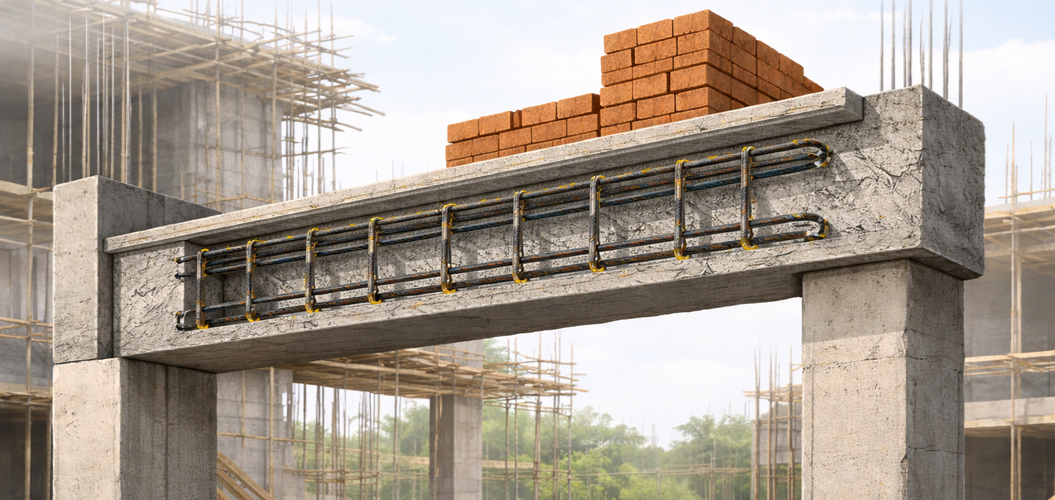
A beam in construction exists to make the building stay strong. It takes weight that would overload slabs or walls and moves it safely towards columns and foundations. Without beams, modern buildings would feel bulky and restricted.
What Is a Beam in Construction?
A beam is a horizontal structural element. It supports loads and transfers them to vertical supports. Sounds straightforward, but on a real project it’s one of those simple things that can go wrong if people treat it casually.
A construction beam works like a controlled route for weight. Instead of allowing load to sit randomly across a slab or a wall, it gathers that load and sends it where it’s meant to go. That control keeps stress balanced.
Beams also don’t operate alone. They are part of a chain:
- Slabs resting directly on them
- Columns positioned to carry the load down
- Foundations that take everything into the ground
If one link in that chain is weak or poorly executed, the beam is often where you see the first signs.
What Does a Beam Actually Do in a Building?
It’s easy to assume beams are just there to hold things up. But if that’s all they did, buildings would still crack and sag in weird places, even with strong material.
Beams control how forces move through the structure. They manage bending. They limit how much a slab can sag over time. They also influence whether a crack stays cosmetic or becomes the kind of crack you keep noticing every time you walk past it.
In everyday terms, beams help:
- Carry slab and wall loads without distress
- Keep floors closer to level as years pass
- Let rooms stay wide without stuffing columns everywhere
- Prevent slow deformation that makes things feel uneven
Beam placement matters too. If beams are planned poorly, layouts get locked in. You can’t easily change spaces later. If beams are planned well, the building stays more flexible, even if the owner doesn’t realise why.
Common Materials Used for Construction Beams
Not every beam is the same, and yes, the material choice matters. Here are some common materials for beam construction:
Reinforced Cement Concrete (RCC)
RCC is the default in India, and it’s not just habit. RCC beams are durable, fire-resistant, and easy to shape for typical residential and commercial designs. When they’re executed properly, they last. When they aren’t, you start seeing small issues show up later.
Steel Beams
Steel beams enter the picture when spans get longer or when speed becomes a bigger priority. Industrial sheds, warehouses, and some commercial structures use steel because it allows lighter systems and quicker assembly. It’s also helpful when you want large, open interior areas.
Timber and Composite Beams
Timber beams are rare in mainstream Indian construction today, mostly used for specific design choices or traditional structures. Composite beams, combining steel and concrete, are more common in advanced systems where efficiency is the goal.
Every option comes with trade-offs. Cost is one part. Execution skill is another. Maintenance, durability, availability, all of it plays a role.
Types of Beam in Construction Based on Support Conditions
One of the easiest ways to understand the types of beam in construction is to look at how beams are supported, because support changes behaviour.
- Simply Supported Beams
Supported at both ends. Common in houses and smaller spans. Behaviour is usually predictable, which is why they’re used so often. - Cantilever Beams
Supported at one end, free at the other. Balconies and projections use these. They demand careful design because the forces travel back to a single support point. - Fixed Beams
Fixed at both ends, meaning they resist rotation. Stiffer, better at controlling deflection, but also more sensitive to detailing.
- Continuous BeamsThese run over multiple supports. They distribute load more evenly and are common in larger buildings, especially where layouts repeat.
Support conditions decide how a beam bends, where it cracks if it does, and how it performs over time.
Types of Beam in Construction Based on Shape and Design
Beam shape sounds like a design detail, but it’s structural too. Shape affects strength, reinforcement behaviour, and material efficiency.
Rectangular Beams
Straightforward and widely used. You’ll find these in most residential buildings because they’re simpler to design and execute.
T-Beams and L-Beams
These occur when slabs act together with beams. T-beams are generally inside spans, while L-beams show up along edges. This slab-beam interaction changes how load is carried.
Flanged Beams
Often used when you need higher capacity without increasing beam depth too much. Common in longer spans and larger projects.
Common Beam-Related Mistakes and Why Proper Design Matters
Beam issues don’t always show up immediately. They creep in, and that’s what makes them tricky.
Typical problems include:
- Beams sized too small to reduce cost
- Reinforcement detailing done poorly
- Weak beam-column junctions
- Future load additions ignored during planning
These mistakes may not cause failure, but they often create cracks, sagging, and uncomfortable vibrations. They also create long-term repair work that nobody enjoys paying for.
How Experienced Builders Approach Beam Design and Execution
On drawings, beams can look perfect. On site, it’s the details that decide whether that “perfect” beam actually behaves well.
Experienced builders focus on things that don’t look dramatic:
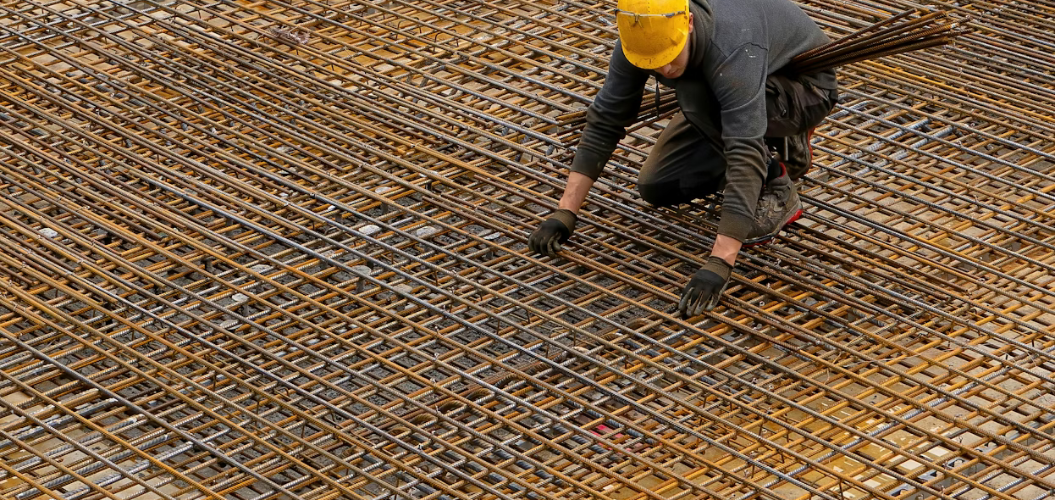
- Bar placement exactly as per drawings
- Proper concrete cover
- Shuttering that doesn’t bulge or shift
- Concreting that’s controlled, not rushed
At RS Builders, beams are treated as structural checkpoints. The focus stays on execution discipline because structural elements don’t forgive shortcuts later. A beam done poorly doesn’t always fail, but it often keeps reminding you it was done poorly, through cracks and unevenness.
That mindset saves far more time and cost than fixing problems after completion.
The Bottom Line
A beam is only as good as the system around it. Slabs, columns, foundations, they all interact, and they all affect each other.
Homeowners don’t need deep technical knowledge, but knowing the basics helps. It helps you ask better questions. It helps you understand why certain design decisions can’t be adjusted later.
A beam in construction might stay invisible, but it decides how the building feels years down the line. If the building ages well, beams played a big part. If it starts showing problems early, beams are usually part of that story too.